
MABON
A Harvest Altar Ritual
A Sacred Practice of Remembering, Receiving & Release
The Fall Equinox is a threshold.
A moment when the light and the dark meet.
The Earth begins her descent into the mystery of autumn, inviting us to slow down, gather what has ripened, and listen for the wisdom that can only be heard when we become quiet enough to receive it.
Mabon is a time of harvest.
Not only the harvest of the Earth, but the harvest of the soul.
The dreams you planted.
The lessons you lived.
The love you received.
The challenges that changed you.
The parts of yourself you reclaimed.
The places where you grew beyond who you once were.
This ritual is an invitation to create a Mabon altar as a living temple, a sacred place where you can honor the season, commune with the Earth, and witness the harvest of your own becoming.
You do not need anything elaborate.
A few offerings from nature.
A candle.
A bowl.
Something beautiful.
Something meaningful.
And your willingness to listen.
Let this be less about creating something beautiful for the eyes and more about creating a space that speaks to your soul.
ENTER THE THRESHOLD
Begin outside.
If you can, take a slow walk in nature.
Walk without needing to arrive anywhere.
Let your pace soften.
Feel the earth beneath your feet.
Notice the changing light.
The temperature of the air.
The colors beginning to deepen.
The leaves surrendering their green.
The seeds preparing to return to the earth.
Let your senses become your prayer.
As you walk, allow the land to speak to you.
You might gather a fallen leaf, acorn, seed pod, stone, dried flower, branch, or other naturally fallen offering.
Take only what is freely given.
And as you gather, ask:
What is the Earth showing me about this season?
Don't search for an answer.
Let yourself receive.
GATHER YOUR MEDICINE
Bring your offerings home.
Place them before you.
Add whatever feels sacred to you:
Apples or pears.
Grains or seeds.
Nuts.
Herbs.
Autumn flowers.
A candle.
Water.
A cup of tea or cider.
A photograph.
A piece of art.
A treasured object.
Something that represents your lineage.
Something that represents your becoming.
Something that represents a dream still waiting to be born.
There is no prescribed altar.
Your altar is an expression of relationship.
Allow your intuition to arrange it.
Let your hands lead.
Notice what wants to be placed in the center.
What wants to be at the edges.
What wants to stand alone.
What wants to be held close.
You are not decorating.
You are creating a container for remembrance.
Create Your Sacred Space
Light your candle.
Take your seat before your altar.
Close your eyes.
Place one hand over your heart.
Place the other over your belly.
Feel your breath moving through you.
Feel the body beneath the stories.
Beneath the roles.
Beneath everything you think you should be.
Simply arrive.
Take several slow breaths.
Then say:
I enter this sacred space as I am.
I honor the Earth beneath me.
I honor the body that carries me.
I honor the wisdom of the season.
I am willing to listen.
Let the altar become a mirror.
Let the candle become a witness.
Let your body become the temple.
Bring your awareness to the year behind you.
Not just what you accomplished.
But what you experienced.
What asked you to grow.
What broke open.
What surprised you.
What nourished you.
What brought you back to yourself.
Ask:
What has ripened in me?
What have I learned that I could not have learned any other way?
What part of myself have I reclaimed?
What am I proud of?
What am I grateful for?
What has this season given me?
Allow whatever arises.
There is no need to make everything beautiful.
The harvest contains both sweetness and sorrow.
We gather it all.
THE BODY KNOWS
Now bring the ritual into movement.
Put on music that feels evocative to you.
Stand before your altar.
Begin slowly.
Let your feet connect with the ground.
Move your hips.
Circle your spine.
Open your chest.
Let your arms reach.
Let your breath become visible.
You are not performing.
You are listening.
Let your body move the stories that words cannot hold.
Dance the harvest.
Dance the gratitude.
Dance the grief.
Dance what you are releasing.
Dance what you are becoming.
Let your movement become an offering.
Dance as prayer.
Movement as medicine.
The body as oracle.
When the movement is complete, return to stillness.
Notice what has changed.
RECEIVE
Return to your altar.
Sit quietly.
Place both hands over your belly.
Take several breaths.
Now ask:
What wants to be nourished in me this autumn?
Not what should happen.
Not what you need to achieve.
Not what anyone else expects.
What wants to be nourished?
Listen.
Perhaps it is rest.
Creativity.
Devotion.
Pleasure.
Healing.
Study.
Love.
Solitude.
Community.
A new body of work.
A new way of being.
Let the answer arise from the body rather than the mind.
OFFER GRATITUDE
Take your journal.
Write down everything you can remember that you are grateful for from this season.
Let yourself include the things that were difficult.
The closed doors.
The endings.
The initiations.
The moments when you had to become someone new.
Sometimes the deepest harvest comes from what we never would have chosen.
Place your gratitude beside your altar.
Then make an offering.
Pour a little water, tea, cider, wine, milk, or another sacred drink into a small bowl.
Hold it between your hands.
Offer gratitude to the Earth.
To your ancestors and teachers.
To the unseen forces that have accompanied you.
To your own body.
Then return the offering to the Earth in a respectful way, where appropriate.
THE SEED OF WHAT IS BECOMING
Now choose one object from your altar to represent the season ahead.
A seed.
A stone.
A leaf.
A piece of fruit.
Something that speaks to you.
Hold it in your hands.
This is not a goal.
It is a seed.
Ask:
What am I willing to tend?
What wants my devotion?
What wants to grow through me?
Hold your object close to your heart.
Then place it at the center of your altar.
Let it become a physical reminder that creation has its own rhythm.
We do not force the seed to bloom.
We create the conditions for it to become what it already knows how to be.
CLOSE THE CIRCLE
When you feel complete, return once more to stillness.
Feel your feet.
Feel your breath.
Feel your body.
Look at the altar you have created.
Notice the beauty.
Notice the simplicity.
Notice what is alive in you.
Place your hands over your heart.
And speak:
I honor the harvest.
I honor the release.
I honor the mystery.
I trust the turning of the wheel.
I trust the wisdom of my body.
I am willing to receive what this next season brings.
Take one final breath.
Bow your head toward your altar.
And when you are ready, rise.
Carry the ritual with you.
Let the altar remain for as long as it feels alive.
Return to it throughout the season.
Light the candle.
Touch the objects.
Move before it.
Write beside it.
Pray beside it.
Rest beside it.
Let it become a living reminder that you are not separate from the cycles of nature.
You are nature.
You are rhythm.
You are constantly becoming.
There are seasons to bloom.
Seasons to create.
Seasons to gather.
Seasons to release.
And seasons to descend into the quiet mystery where the next version of you is taking root.
May this Mabon bring you home to your body.
May you honor the fullness of what you have lived.
May you release with reverence.
May you receive with an open heart.
And may you remember—
Your body is the temple.
Your movement is the prayer.
Your life is the ritual.
Blessed Mabon. 🍂
Lammas Ritual of Gratitude & Sacred Harvest
An Embodied Ceremony for the First Harvest
"The harvest is not measured only by what fills our hands, but by what has transformed our hearts."
Lughnasadh, the First Harvest, is an invitation to pause.
To gather the fruits of your inner and outer life.
To honor the path that has brought you here.
To remember that abundance begins with gratitude.
This ritual is an offering, a gentle ceremony to reconnect with the wisdom of the Earth, the rhythm of your body, and the quiet knowing of your soul.
Allow yourself at least an hour where you will not be disturbed.
Turn off your phone.
Step outside if you are able.
Let nature become your sanctuary.
Create Your Sacred Space
Gather a few simple offerings.
• A candle to represent the light within.
• A small loaf of bread or seasonal fruit as a symbol of the harvest.
• Fresh flowers, herbs, or grains gathered with gratitude.
• A bowl of water.
• A journal.
• A blanket or shawl if you will be sitting upon the Earth.
Take a few moments to arrange these items with beauty and intention.
Remember, creating an altar is not about decoration.
It is about relationship.
Opening the Circle
Stand with your feet upon the Earth.
Close your eyes.
Feel your breath.
Feel the weight of your body being held.
Imagine roots extending from the soles of your feet deep into the rich soil beneath you.
With every inhale, receive.
With every exhale, soften.
Whisper:
"I arrive with gratitude.
I arrive with humility.
I arrive willing to remember."
Light your candle.
Take three slow breaths.
Allow the ceremony to begin.
Awakening the Body
Before we harvest the wisdom of the heart, we awaken the wisdom of the body.
Begin with slow circles of the wrists.
The ankles.
The shoulders.
Let your spine ripple like flowing water.
Reach your arms toward the sky.
Bow toward the Earth.
Allow your movement to become intuitive.
No choreography.
No performance.
Simply listen.
If music calls you, let your body dance.
Dance as the grain dances in the summer wind.
Dance as though your ancestors are dancing beside you.
Dance until you no longer know where your movement ends, and the Earth begins.
Pause.
Place both hands over your heart.
Notice what is alive within you.
The Harvest Reflection
Return to your journal.
Without rushing, reflect upon these questions.
What has ripened within me since the beginning of this year?
What challenges became unexpected teachers?
What relationships have nourished my spirit?
What old stories have I finally outgrown?
Where have I witnessed abundance that I once overlooked?
Write slowly.
Allow gratitude to lead.
Bread as Blessing
Hold the bread or seasonal fruit in your hands.
Remember the countless seen and unseen relationships that made this nourishment possible.
The seed.
The rain.
The soil.
The insects.
The sun.
The farmers.
The hands that prepared it.
Offer a blessing.
"May I receive this harvest with gratitude.
May I become good soil for what is still growing.
May my life nourish others as I have been nourished."
Break the bread slowly.
Eat with complete presence.
Let this become communion with the living Earth.
Offering Back
Nature teaches us that every harvest includes reciprocity.
Take a flower.
A pinch of grain.
A few herbs.
Or simply place your hands upon the Earth.
Offer your gratitude back.
You might say:
"Thank you for holding me.
Thank you for feeding me.
Thank you for teaching me that all life moves in sacred cycles.
May I walk gently upon this Earth.
May I become a blessing wherever I go."
Sit quietly.
Listen.
The Earth speaks in silence.
Receiving the Vision
As evening approaches and the Full Moon begins to rise, allow yourself to become still once more.
Close your eyes.
Imagine yourself standing in a field at harvest.
Behind you lies everything you have cultivated.
Before you stretches an open horizon.
Ask quietly:
What vision is asking to grow through me now?
Do not search for an answer.
Receive.
Trust whatever image, word, feeling, or sensation arrives.
Write it in your journal without judgment.
Closing the Circle
Place one hand upon your heart.
One hand upon your belly.
Feel your breath moving between Heaven and Earth.
Whisper:
"I honor what has been harvested.
I welcome what is still becoming.
May my life remain rooted in gratitude.
May my body remember the wisdom of the Earth.
May every step I take become an offering."
Blow out your candle.
Carry one small act of this ceremony into the days ahead.
Bake bread.
Share a meal.
Dance barefoot.
Offer kindness.
Plant seeds.
Walk slowly.
Remember often.
For the deepest rituals do not end when the candle is extinguished.
They continue in the way we choose to live.
May this First Harvest remind you that abundance is not something we chase.
It is something we learn to recognize.
Blessed Lughnasadh.
May your harvest be filled with beauty, gratitude, and grace.
🌑 New Moon Dream-Seeding Ritual
A Yogic & Somatic Practice for Rooting Vision
Duration: 25–40 minutes
Elemental Focus: Earth & Breath
Best Time: Evening or early morning, within 48 hours of the New Moon
Preparation | Creating the Container
Before you begin, tend to your space as an act of devotion.
Light a candle, or place a stone, bowl of soil, or seed nearby
Wrap yourself in warmth, shawl, blanket, or sweater
Turn off all distractions
Sit or lie in a position where your spine can be long and your belly soft
Let this be a ritual of listening, not striving.
Nothing needs to be achieved here.
I. Arrival | Coming Home to the Body
Gently close your eyes.
Place one hand on your lower belly, the other over your heart.
Allow your weight to drop
into the earth,
into the floor,
into whatever is holding you.
Silently affirm:
I arrive in my body.
I am safe to be here.
Pause.
Feel the support beneath you.
Let yourself be received.
II. Breathwork | Rooted Presence
We begin with a grounding yogic breath to settle the nervous system and invite embodied awareness.
Earth-Rooted Breath
Inhale slowly through the nose for a count of 4, feeling the breath gently expand the belly.
Exhale through the nose for a count of 6, allowing the body to soften and descend.
Continue for 7 rounds.
With each exhale, imagine gravity doing the work
hips heavy,
legs relaxed,
jaw unclenched,
shoulders melting.
If the mind wanders, tenderly return to the sensation of breath moving in and out of the belly.
Optional variation:
On each exhale, whisper silently:
Here.
Now.
III. Visualization | Rooting Into the Dark Soil
Now allow an image to arise.
Visualize roots extending from the base of your spine and the soles of your feet.
They grow slowly, organically, without force or urgency.
These roots move downward into dark, fertile soil.
This soil is alive.
It holds memory, wisdom, and dormant possibility.
Nothing needs to be decided here.
Nothing needs to be proven.
Rest in the felt sense of being rooted,
held by the dark that knows how to grow things.
Stay for several breaths.
IV. Dream-Seeding | Planting Without Forcing
From this grounded place, invite in a feeling—not a goal, not a plan.
Ask softly:
What quality wants to grow through me this cycle?
What does my body long to experience more of?
Let the response arise without effort.
It may come as a word, an image, a sensation, or a quiet knowing.
Now imagine offering this essence into the soil beneath you
like a seed placed gently into the earth.
You do not need to shape it.
You do not need to manage its outcome.
Simply offer it.
Silently say:
I plant this seed in trust.
I allow it to grow in its own time.
V. Integration | Listening to the Body’s Wisdom
Return awareness to your breath.
Notice how your body feels now compared to when you began.
Ask inwardly:
What does my body need to support this seed?
What rhythm, nourishment, or boundary will help it grow?
Listen without urgency.
Let the answer be simple.
Let it be kind.
VI. Closing | Sealing the Ritual
Bring both hands to your heart.
Take one slow, full inhale through the nose.
Exhale with a gentle sigh through the mouth.
Offer gratitude
to your body,
to the dark soil,
to the unseen forces already at work on your behalf.
Extinguish the candle if you lit one.
Carry this seed with you
not in your mind,
But in your body.

St Ruth Denis

Goddess Ishtar
Drawing inspiration from the feminine divine, Devadasi & the soul memory of the temple dancer rites.
Honoring the lineages that create the rooted structure of these practices of many ancestors who have come before. Movement and dance are inherent qualities, not only to humans but to all of nature and the cosmos. From the creation of the universe to the first heartbeat of the fetus in the womb, rhythm and dance have always existed. For tens of thousands of years, humans have used dance as an integral part of ritual, prayer, and reaching other states of consciousness, for healing, and facilitating contact with the Divine. It is believed that the soul of a people is woven into the steps of their dances.
The Origins of “Belly Dance” is extremely old and traces of it can be found up to 6,000 years ago, based in pre-Christian pagan societies who worshipped nature & the feminine divine. This dance was women’s fertility magic & helped in childbirth. The origin of the name ‘belly dance’ comes from the French Danse du ventre, which translates as “dance of the stomach”.
Her-Story
A common thread in many ancient civilizations is sacred dance, dancing before the goddess & god as an essential element in all rituals. The rituals, being of sacred knowledge and origin, are practiced only by women initiated into lineages by their mothers & grandmothers. Within the context of the ancient Hindu temple, a devoted temple dancer, popularly known as a Devidasi, performed for the sole purpose of devotional offerings to specific gods/goddesses.
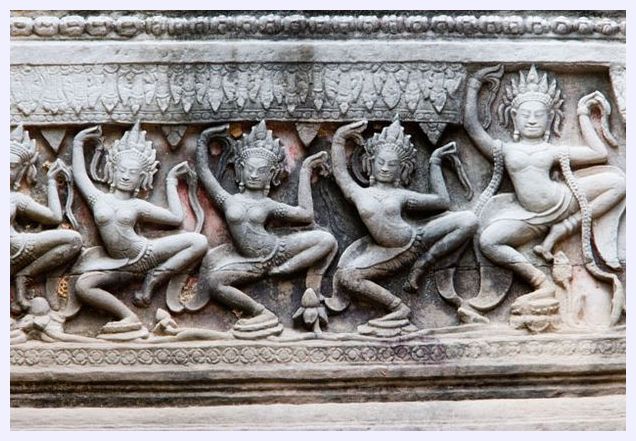
These women, also known as conduits & receptors, possessed the ability to manifest within the material body, the heavenly dance of Apsaras. The Apsaras are the celestial muses who incarnated in women's bodies during ritual, yet remained immortal & made of the heavens. Devidasi dancers dedicated their lives to holding the energy of the temples & dancing in devotion to the deities. The antiquity of the Devadasi tradition mystifies its origin. The temple inscription & architecture within the archaeological record provide relevant and significant information regarding this holy tradition. Inscriptions can be found, dating as far back as 611 A.D., in countries such as Egypt, Greece, Assyria, and Babylon. It was customary in many of these traditions for the nobles to employ their unmarried daughters for the service of the Goddess. In Babylon, not a single girl before her marriage could be spared from this duty. This was a binding obligation; however, the custom of dancing after marriage was not an obligation. In Sumerian times, the Devadasi were a highly respected tradition of Babylon & as Ishtar was the famous deity of Babylon, the Devadasi were appointed as Ishtar herself.

In Egypt, priestesses performed ritual dances that mimed significant events in the story of a god/goddess, they imitated stories of the stars & cosmic creation myths. The Afterlife is a major theme of Egyptian religion & much of one’s life was spent preparing for reincarnation. At Egyptian funerals, women danced to express the grief of the mourners. The Egyptian temple dancers had various initiations to become a temple keepers, many of whom were devoted to the Temple of the goddesses Isis & Hathor.
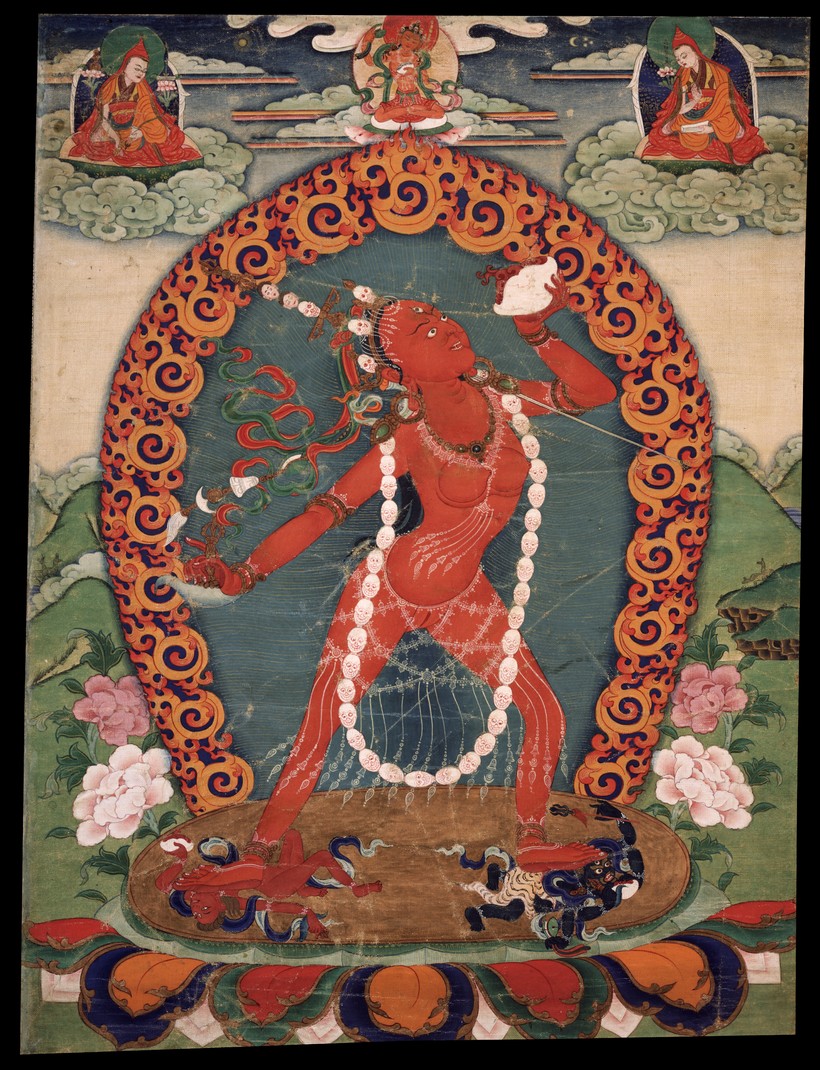
Vajrayoginī Buddhist tantric deity, She is often described as carrying the nectar of transmutation, "the Dakini who is the Essence of all Buddhas. "She is a female Buddha and a Dakini, a transcendent passion that is free of selfishness and illusion; she intensely works for the well-being of others and for the destruction of ego-clinging. She is seen as being ideally suited for people with strong passions, providing a way to transform those passions into enlightened virtues. She is a tantra deity and her practice includes methods for preventing ordinary death, intermediate state Bard,o and rebirth (by transforming them into paths to enlightenment), and for transforming all mundane daily experiences into higher spiritual paths. Practices associated with her are Chod and the Six Yogas of Naropa.

Throughout all history, the mythic temple dancer appears. In Greek history, the temple dancers were appointed in the temple of Apollo, the Sun God. Many of these rites were performed by the mythological Maenads, whose dancing is devoted to the harvest rites & for the god Dionysus. The connection to priestesses of Delphi & oracular divination was a well-known practice in the temple, and it was honored that these women held deep communion with the spirits & offered dance as a spiritual devotion.

The roots of Belly Dance originated from the Ouled Naïl people, whose women were trained in arts, dance, and song. This tribe of nomadic people brought their traditional arts to the public for performance in exchange for money. Adorned in traditional costumes and jewels, these women were exotic sights. These women would literally wear their entire wealth.
In belly dancing, the term Ouled Naïl refers to the style they are noted for their way of dancing. "Belly Dance" is a Western term describing raqs sharqi, which is the Arabic word for Oriental Dance and the basis of Egyptian, Turkish, and Persian dance.
The traditional dances of the Middle East, also known as Oriental Dance, span a large variety of folk traditions throughout North America, the Middle East, and Central Asia.
Mata Hari 1905, Mata Hari began to win fame as an exotic dancer. She was a contemporary of dancers Isadora Duncan & Ruth St Denis became leaders in the early modern dance movement, which, around the turn of the 20th century, looked to Asia and Egypt for artistic inspiration. Critics would later write about this and other such movements within the context of Orientalism.
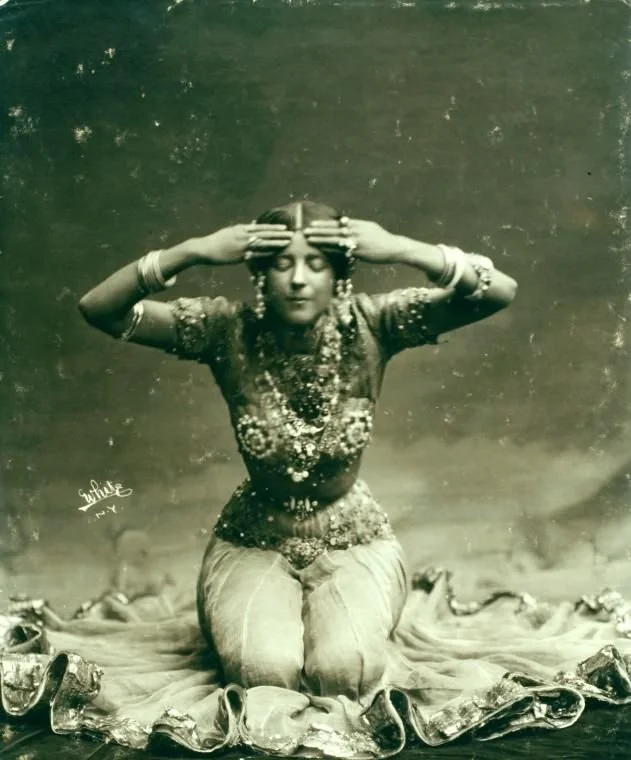
St Ruth Denis
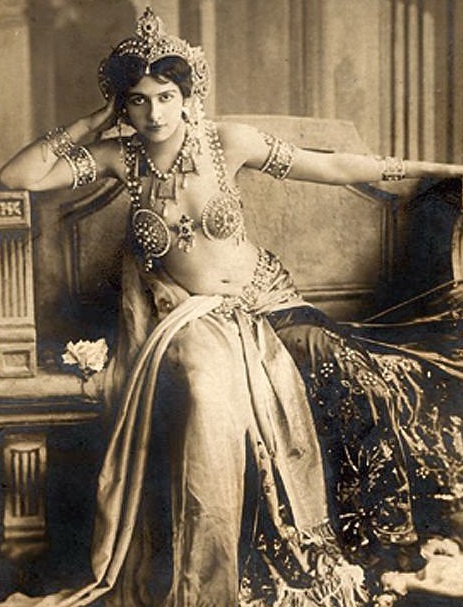
Mata Hari

Belly dancing is natural to a woman’s bone and muscle structure with movements emanating from the torso rather than in the legs and feet. The dance often focuses on isolating different parts of the body, moving them independently in sensuous patterns, and weaving together the entire feminine form. Belly dancing is generally performed barefoot, thought by many to emphasize the intimate physical connection between the dancer, her expression, and Mother Earth. Women often danced with their whole families, including their grandmothers.

Jamila Salimpour
Belly dance innovator Jamila Salimpour formed Bal Anat as a truly unique and exciting entertainment experience. She named it for “Bal,” the French word for a dance gathering, and “Anat,” an ancient Mesopotamian mother goddess: Dance of the Mother Goddess. Bal Anat dance troupe Originally created in 1968 for the spectacle and wonder of the Renaissance Pleasure Faire in Northern California, Innovative Jamila Salimpour’s groundbreaking presentation was the first to integrate dancing with and balancing a sword, a now quintessential belly dance prop. The feminist movement, in the 1970s and 1980s in the USA, rediscovered belly dance as a form of dance that empowers women. All women of any age & background. There is so much more to share on the Her-story & Lineages of this ancient & mesmerizing Art Form.

Belly dancing costumes are often colorful, flowing garments, accented with flowing scarves and veils. Finger cymbals (made of brass and dating back to 200 B. C. as well as exotic jewelry, including intricate belts made of coins that, in earlier days, comprised the family’s wealth so that it might be portable in the event the woman needed to move quickly or flee. Other interesting accessories used during the dance are swords, snakes, large vessels, and even huge candelabras, complete with flaming candles.
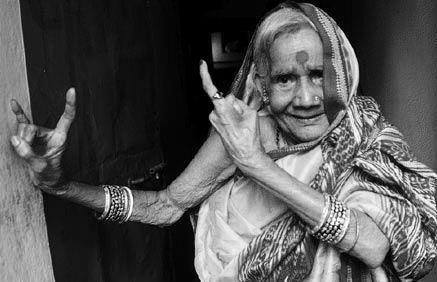
Sashimoni
This woman is such a great inspiration to me.
At 87, Sashimoni is the oldest surviving Devadasi in Odisa. There is a strange romance associated with the word 'Devadasi'. A romance that only gets more enigmatic what with records saying that the number of Devadasis in Puri has now been seeing a sharp decline from 25 about 100 years ago to nine in the 1956 Gazette of Odisha to four in the 80s to just two who are now alive to tell the tale. Myths abound, and so do memories of the days when Devadasis or Maharis were regarded and respected as those great women who could control natural human impulses, their five senses and submit themselves completely to God.
By: Rajan G Srikrishnan
You can see how I have been totally inspired & devoted my life’s path to learning & now sharing these sacred practices.
Thus far, my life experience & training have taught me the marriage of yoga & dance, as well as including the ancient sister science to yoga, Ayurveda ritual & practices. These 3 ancient pathways have come together in such profound ways. They are the core triad of all my offerings.
“The Priestess and the Performer
The priestess in ancient times was integrated into her community. With time priestesses as keepers, and dancers of ritual disappeared. The altars, which had been centered in each family’s hearth, were moved out of the temples & into the church.

Churches replaced the communal worship grounds and centers. Temples were now viewed as separate edifices to a distinct institution of priests. Ritual became to be the domain of only select individuals on behalf of the community in place of community participation and self-expression. Organic rituals became prescribed religion. Dance as an integral part of women’s spiritual practice shared a parallel fate with the priestess.
As many religions forgot their roots and were forced to conform, the priestess now in secret led communal nature dances. But the sacred dancer was now made the servants of the temple and its priests. The momentous split between artistic forms of worship in a devotional setting. The social division of priests and worshippers now made masters and servants, brought about a split between the sacred and the profane.
Devotional dances gradually became commissioned works for the enjoyment of paying ruling spectators, for provocative entertainment. Dance was transformed from religious art and rite to a work of art intended for observation and subject judgment by the observer. From these shifts arose a culture of dance and theatre as entertainment.
The universal feminine principle of spirit-matter connection was transformed into the duality of seductress/virgin, priestess/midwife these roles were considered black magic. This is primal exotic illusions appear. Repeating itself over and over in history.
Sexuality and procreativity were split from a concept of belonging to nature and the flow of seasons. In addition the sacred dance became a spectacle and only entertainment. Another major transition occurred when men gradually began emulating and then taking over women’s roles in dance. Increasing the propaganda against her and her rituals. Men dressed as women and danced for their kings.
The few remained dancing in the priestess's steps. She is the lens focusing for the others the higher energies. The sustaining life that constitutes and defines earthly existence. She acts as the transmitting agent of divine emanations. Her dance is a system of movements, gestures, prayers, and devotion to the invisible forces of life. The function of the priestess is to facilitate the groups and gingival process to teach and remind how to be receptive". ~Unknown